

By Roger van Zandvoort
At first, Trinks was not an enemy.
Karl Friedrich Gottfried Trinks belonged to the first serious generation of homeopaths after Hahnemann. He was young, sharp, disciplined, and drawn into the new medical movement through Carl Georg Christian Hartlaub. Hartlaub and Trinks would become one of the important publishing pairs of early German homeopathy. Their works preserved provings, clinical material, and repertorial clues that still matter today.
Trinks had seen Hahnemann in Leipzig. He visited him at Coethen. He was not an outsider throwing stones at the movement from a distance. He was inside the house.
And that was exactly why the trouble mattered.
A Brilliant but Difficult Insider
Trinks was not built to remain a docile disciple. Contemporary descriptions make him sound clear, critical, blunt, practical, and severe. He disliked anything that looked like mysticism or humbug. He supported lower dilutions and was suspicious of high-potency enthusiasm. He was also, at least at times, open to combinations or mixed medicines, something that strict Hahnemannians could hardly tolerate.
To Hahnemann, homeopathy was not a loose reform movement. It was a disciplined medical art: single remedies, careful provings, minute doses, and fidelity to the law of similars. A physician could not simply borrow the name of homeopathy while smuggling old-school habits back through the side door.
So Trinks became dangerous in a very particular way. He was not ignorant. He was not irrelevant. He was clever enough to matter, close enough to the sources to influence others, and independent enough to resist the master's authority.
The Manuscript That Would Not Appear
The quarrel sharpened around one of Hahnemann's central works: the second edition of The Chronic Diseases.
Hahnemann believed that the publication of this edition had been obstructed. His publisher Arnold delayed. The manuscript lay unprinted. Hahnemann grew furious. In a letter to Stapf, he blamed the hostile spirit of Trinks and accused him of interfering behind the scenes. To Hahnemann, Trinks had not merely disagreed with him. He had helped delay the appearance of one of the pillars of his mature doctrine.
Whether Hahnemann was fully fair is another question. The evidence we have is Hahnemann's anger, not a court record. But the anger itself is important. It shows how personally he took the obstruction, and how completely Trinks had become, in his mind, a hostile force within homeopathy.
This is the first real center of the story: a founder, late in life, trying to secure his legacy; a publisher delaying the work; and a former ally whom Hahnemann believed was working against him.
The Nenning Problem
There was another wound: the problem of "N-g."
Hartlaub and Trinks published provings in which some contributors appeared only by initials. One of the most important was "N-g.", later identified as Nenning. Hahnemann distrusted this kind of anonymity. In his notes he complained that Hartlaub and Trinks had given the homeopathic public symptoms from a man hidden behind two letters, and that many of these symptoms were diffuse or carelessly expressed.
Later, Constantin Hering pushed back sharply. Hering said Hahnemann had been wrong about this. According to Hering, Nenning was known, not truly anonymous, and the use of initials had partly to do with Austrian restrictions on publication. Hering blamed Trinks' malicious opposition for helping provoke Hahnemann's indignation.
Here the quarrel touched something deeper than personality. It touched the credibility of provings themselves.
Who had observed faithfully?
Who had edited responsibly?
Who had preserved the source?
Who had distorted it?
For a system built on proving symptoms, these were not small questions.
What Happened to Trinks' Work?
The tempting story is simple: Hahnemann disliked Trinks, therefore Trinks' great works were neglected and never translated into English.
But history is usually less tidy than that.
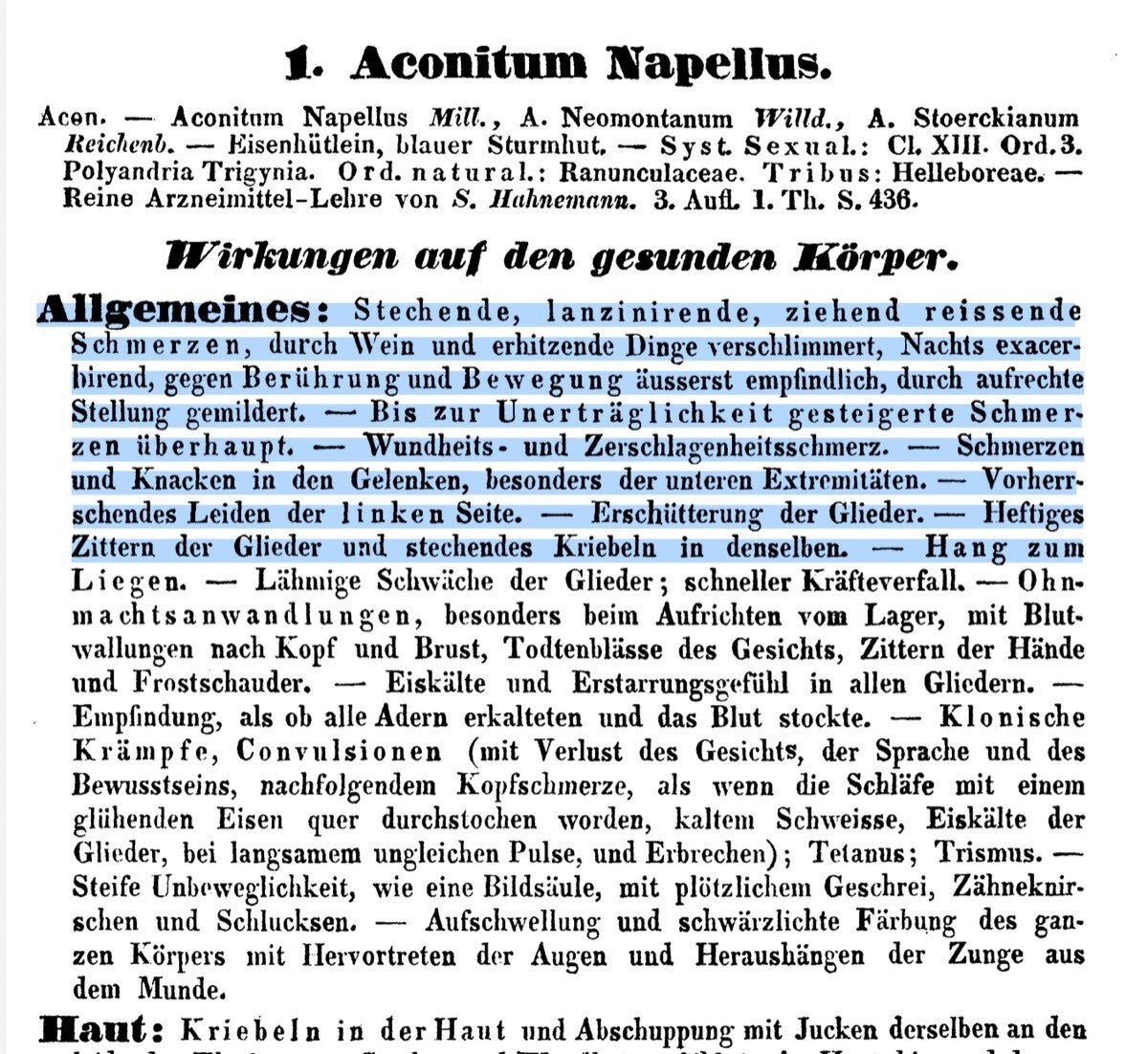
Trinks was not erased. His name continued to circulate. Noack and Trinks were used in English-speaking journals. Allen drew on Hartlaub and Trinks. Hering argued fiercely about Nenning and still took the proving tradition seriously. The material entered homeopathy, but often indirectly, through extracts, compilations, repertories, and later materia medicas.
The larger Hartlaub and Trinks works were simply too large, too German, too dense, and too inconvenient for the English-speaking market. Translating them completely would have been a major scholarly and publishing labor. Instead, English homeopathy usually took what it needed in pieces.
So the neglect was real, but it was probably not a single act of revenge. Hahnemann's hostility gave Trinks a shadow. The nineteenth century then did the rest: selective translation, practical abridgment, and the slow disappearance of sources that were not made easy to read.
The Finish
The good story, then, is not that Hahnemann hated Trinks and buried him.
It is better than that.
It is the story of a founder trying to protect the purity of a new medical art; a brilliant early follower who would not stay inside the lines; a delayed manuscript that became a personal betrayal; and a proving controversy that reached into the foundations of materia medica.
Hahnemann could forgive many things in opponents outside homeopathy. But Trinks was different. Trinks was inside the movement. He knew the language. He knew the sources. He had authority of his own.
That made him useful.
And, to Hahnemann, unforgivable.
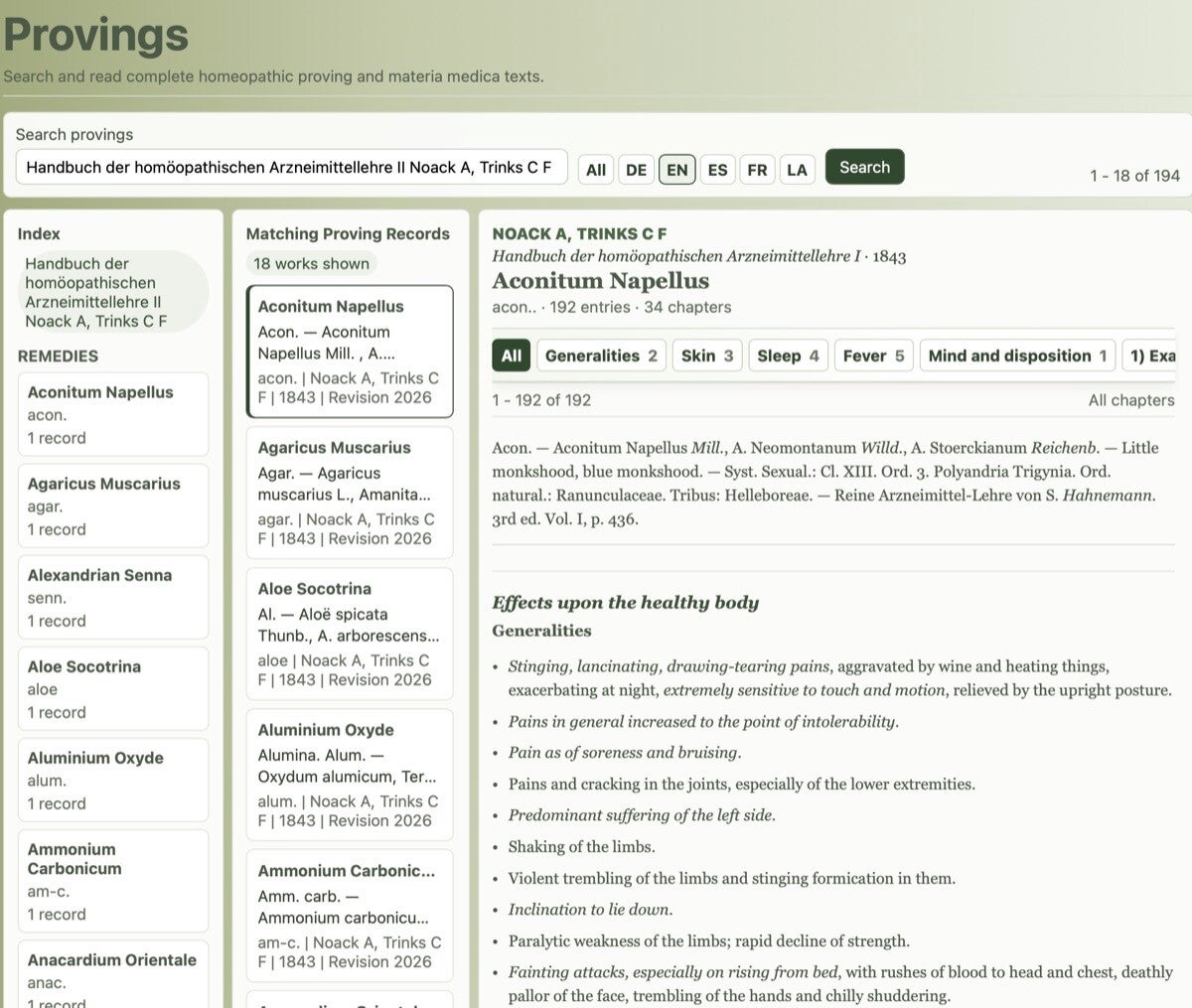
But perhaps the better ending belongs to the present. The old German pages are no longer only a rumor behind later extracts and repertory references. To make everybody happy, or at least to make the source usable again, we now have an English translation of Trinks' original text: readable, searchable, and open for fresh study.
Sources and Notes
- Thomas Lindsley Bradford, The Life and Letters of Dr. Samuel Hahnemann, especially the letter to Stapf concerning Trinks and the delayed second edition of The Chronic Diseases.
- Timothy F. Allen, The Encyclopedia of Pure Materia Medica, Alumina, including Hahnemann's note on "N-g." and Hering's later correction.
- Hahnemann House Trust, biography of Karl Friedrich Gottfried Trinks.
- Elias Carlos Zoby, "Hartlaub & Trinks Pure Materia Medica: to save it or to lose it?", 2003.
- Local Curar/Homeopathic Library review material for Hartlaub and Trinks, Noack and Trinks, and related English-periodical witnesses.
Add comment
Comments