

By Roger van Zandvoort
Thuja occidentalis, the North American white cedar or "tree of life," entered homeopathic materia medica through several very different kinds of evidence. Indigenous knowledge, colonial reports, botanical identification, Hahnemann's preparation, individual provings, clinical reports, and modern toxicology are all part of the history. They are not interchangeable.
A familiar remedy with a complicated history
Thuja is familiar to every homeopath. That familiarity can create a false sense that its identity and evidence are simple. They are not. Even before we read a single symptom, we must ask four separate questions: Which plant was used? Which preparation was made? Who supplied the information? And was that person a knowledge contributor, a patient, a prover, or merely the recorder of someone else's account?
This source-first study begins with those distinctions. It does not assign new symptom grades, certify a total number of provers, or offer clinical advice. Its purpose is narrower: to show what can presently be traced, what must remain separate, and where the original witnesses still need to be checked.
First identify the tree
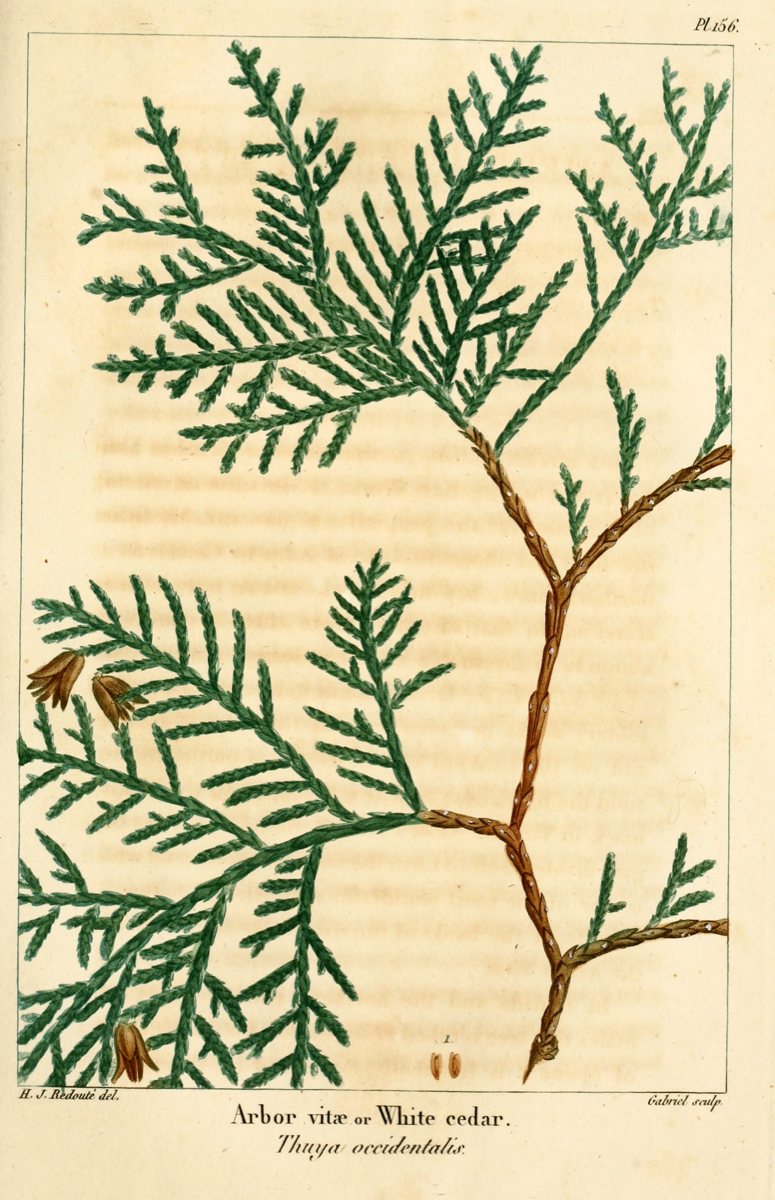
Kew accepts Thuja occidentalis L. as a species in the cypress family, Cupressaceae. Its natural range lies in eastern North America, from the Great Lakes toward the Atlantic. The names "arbor vitae" and "tree of life" came into European use, but both names were later applied to other conifers as well. A historical text that says only "cedar," "arbor vitae," or "tree of life" is therefore not automatically a species-level identification.
The material matters just as much as the name. Fresh crushed twigs and expressed juice, alcohol tincture, dried triturated twigs, distilled essential oil, leaf tea, steam, topical salve, and a compound poultice are distinct preparation lanes. An effect reported after concentrated essential oil cannot simply be transferred to a tincture, a leaf tea, or a highly diluted preparation.
Annedda and the danger of retrospective certainty
During Jacques Cartier's second voyage, in the winter of 1535-36, the Stadacona resident Domagaya described his recovery from the disease affecting Cartier's crew. Two unnamed women collected branches and demonstrated the preparation. One or two crew members first tried it, followed by a larger group. The account was printed in 1545.
This episode is often attached to the later name "tree of life" and then retrospectively identified as Thuja occidentalis. Yet the plant called Ameda or Annedda in the surviving witnesses remains botanically disputed; other conifers are plausible. Domagaya, the two women, the first recipients, and the later group are historically important people in the account, but they cannot be entered into a species-verified Thuja denominator.
There is another distinction. The published narrative is a colonial recorder's text about Indigenous expertise, not an Indigenous-authored witness. The originating knowledge and the European record of it must both be named without allowing the second to erase the first.
Indigenous knowledge is not a proving
Pehr Kalm's 1749 account also contains several voices. An unnamed Iroquoian informant told him about a cedar-leaf decoction for cough. M. de Lusignan separately reported the topical use of fresh leaves and grease among several people with rheumatic pain. Kalm also recorded a compound poultice and its burning effect. The informant is a knowledge source, Lusignan is a reporter, and the treated people form an unpartitioned group. None of these roles is equivalent to a healthy prover.
Later ethnobotanical publications require the same care. Huron H. Smith recorded distinct Flambeau and Pillager Ojibwe names and uses in 1932. A modern Indigenous botanical survey restores the names of Mary (Mrs. Michel) and Annie of the Wake'gizek family, who taught Frederick Wilkerson Waugh about cedar and other plant medicine at Wikwemikong in 1916. The survey also names Alyssa General and Tehahenteh Miller as contemporary contributors. These are knowledge attributions, not four new provers or four cured patients.
The proper record preserves Nation or community, Indigenous plant name, contributor, recorder, date, plant part, preparation, and reported use as separate fields. It also respects the limit of the published witness: public documentation does not make private or ceremonial knowledge freely available for expansion or reinterpretation.
Hahnemann changes the evidence class
Hahnemann published his first Thuja compilation in volume V of the Reine Arzneimittellehre in 1819. The accessible 1826 edition describes a preparation from fresh green material and explicitly cites Kalm before presenting proving symptoms and therapeutic inferences.
Here the evidence class changes. Hahnemann is no longer merely preserving a historical use report; he is defining a medicinal preparation and assembling pathogenetic observations. Yet the first edition and the later edition must still be collated. The local 1826 text is useful for access but not a substitute for checking the printed page and its authority marks.
Allen's 92 numbers are not 92 provers
T. F. Allen's 1879 Encyclopaedia of Pure Materia Medica gives 92 numbered Thuja authorities or exposure references. Those numbers are not a census of 92 independent people.
The key shows repeated experiments under separate numbers. Frohlich occupies six numbers; Dr Mayrhofer three; Dr Holleciek seven. One number covers three children. Another abbreviated identity may overlap with a person already counted. Wolf reports an experiment on himself and also claims experience with "a hundred others," but Allen does not provide a person-by-symptom partition for that group.
This matters because repetition by one person is not the same as confirmation by several people. Six authority numbers attached to Frohlich remain one person with several exposures. Conversely, the single authority number for three children represents three exposed people, but the symptoms cannot be assigned to each child separately from Allen's key alone.
The Austrian proving series
The mid-nineteenth-century Austrian series is especially important because it records named men and women, repeat dosing, different preparations, pre-existing complaints, and at least one grouped entry. Its richness is exactly why it must not be reduced to a simple total.
Dr Mayrhofer's first two listed experiments used tincture, while his third used distilled twig oil. Those episodes belong to one person but different material lanes. Several other participants had pre-existing disease or received other medicines. Prof. von Zlatarovich undertook a long Thuja experiment over many months. The source can support a detailed individual history only after its pages are transcribed and linked person by person, not by treating every numbered exposure as a new prover.
Allen is invaluable here as a map. But Allen is already a compilation. The Austrian journal, Wolf, Schreter, and Hahnemann remain the earlier witnesses that must be checked before an individual symptom is graded or assigned with confidence.
Toxicology belongs in its own lane
Concentrated Thuja essential oil and thujone-containing products can cause serious poisoning. Modern safety reports are therefore relevant, but they cannot be blended indiscriminately with proving material. A 1981 paper describes eight intoxications across several different plant oils, not eight proven Thuja cases. A later infant seizure report includes both a Thuja-labelled product and an herbal chest salve, leaving a mixed exposure.
Plant, tincture, distilled oil, mixture, and highly diluted preparation should remain separate in the evidence record. A safety reference may establish poisoning potential without contributing even one person-level homeopathic proving symptom.
What the present evidence allows us to say
The history of Thuja becomes clearer when we resist the temptation to aggregate too soon.
- Cartier's Annedda episode documents Indigenous knowledge and reported treatment, but the species remains disputed.
- Kalm preserves distinct Indigenous, military, and observational voices; they are not one homogeneous Thuja proving.
- Hahnemann defines a preparation and a proving tradition, but the 1819 and 1826 witnesses still require collation.
- Allen's 92 numbered references are source markers, not 92 independent provers.
- Repeat exposures, grouped participants, pre-existing disease, and different preparations must be recorded explicitly.
- Modern toxicology is important for safety, but it remains separate from proving and cure evidence.
Source-first materia medica does not make the history smaller. It makes the people and materials more visible. It restores Indigenous contributors to their proper role, prevents repeated experiments from inflating the prover count, and keeps uncertainty where the original witnesses have not yet resolved it.
The unresolved work is part of the result. The 1819 Hahnemann first edition, the Austrian journal pages, Wolf and Schreter's originals, and source-level modern poisoning reports still need direct collation. Until then, no grand prover total and no new symptom grade should be certified.
Source note
This article is adapted from the contributor-first research pilot completed on 27 September 2026. Principal witnesses include Cartier's Bref recit (1545), Kalm's 1749 field account, Hahnemann's Reine Arzneimittellehre V (1819/1826), the Oesterreichische Zeitschrift fuer Homoeopathie II (1845), Allen's Encyclopaedia of Pure Materia Medica IX (1879), Huron H. Smith's Ethnobotany of the Ojibwe Indians (1932), the Greenbelt Indigenous Botanical Survey, NATIFS, Kew Plants of the World Online, and modern toxicology and safety sources.
Image credits: Botanical plate from Francois Andre Michaux, The North American Sylva (1819), illustrated by Pancrace Bessa and engraved by Gabriel, Biodiversity Heritage Library / Wikimedia Commons, public domain. Austrian journal title page and Zlatarovich proving page, Oesterreichische Zeitschrift fuer Homoeopathie, volume II (1845), public-domain facsimiles.
Traditional use, proving, treatment, and intoxication remain distinct. This historical research article is not medical advice.
Add comment
Comments