

A Historical Remedy Study
Roger van Zandvoort
The golden rhododendron of the northern Asian mountains: hunters' knowledge, local tea and household medicine, and the people behind the first homeopathic trials.
Research edition, 27 September 2026. Historical use is described, not recommended. Counts remain provisional.
The plant behind Rhod.
Homeopathic Rhod. entered the nineteenth-century books as Rhododendron chrysanthum Pall. The name now belongs, according to Kew's plant catalogue, under Rhododendron aureum subsp. aureum, in the heath family, Ericaceae. The historical name remains important because it is the name printed in the original medical sources.
This is not every plant called rhododendron. In particular, R. adamsii, often associated with the tea name sagan-dalya, cannot be folded into Rhod. Pallas named his shrub R. chrysanthum and pointed to Gmelin's earlier botanical account and plate; that gives us a much stronger plant anchor than a common name alone.
How the record grew
1769: Gmelin, Flora Sibirica IV, pp. 121-124
Botanical description, hunters' use after strenuous mountain work, a guide's knowledge, and Steller's reports of stronger effects.
One described informant; users unnumbered
1775-76: Georgi's name; Pallas, Reise III, pp. 369-370
The named shrub, mountain setting, local tea use, effects of stronger preparation, and one named self-treatment.
One named person; groups unnumbered
1779: Kölpin, Praktische Bemerkungen
Fifteen numbered cases of treatment for gout and related pain, with both adverse effects and varied outcomes. Later authors drew on this earlier book.
15 separate patients; not 15 cures or provers
1831: Seidel, Sibirische Schneerose
Earlier medical history followed by trials in people described as healthy; symptoms marked by participant. Public digitization of the journal volume.
Four clearly described trial participants; three further marks to resolve
1846: Stapf and Hempel, Additions to the Materia Medica Pura
English translation and edited transmission of Seidel's account, not a fresh proving.
Do not recount Seidel's people
1859: Lembke, Neue Zeitschrift für homöopathische Klinik, p. 197
Original account of five self-trials and separate unsuccessful treatment of people with longstanding rheumatism.
One further prover; patients unnumbered; no cures reported
1878: Allen, Encyclopaedia VIII
Authority key distinguishes repeated doses, earlier medical reports, and later proving leads.
Numbered authorities are not a people total
Late 19th century: Hering, Guiding Symptoms
Later clinical synthesis with named reporters and person-level case leads; original publications still require review.
No new cure total from this compilation
1892-93: Macfarlan, The Homoeopathic Physician XII-XIII
Original report of one woman's dental-neuralgia treatment, repeated the following year.
One described patient and claimed recovery, not two
1996; 1997 summary: König and Santos-König, Rhododendron dream proving; public contemporary summary
A distinct later trial, reported as double-blind, with dreams recorded after a pre-observation period. The summary is not the full original publication.
12 reported participants (7 women, 5 men); individual symptom supports not yet audited
2005: Changbai Mountain medicinal-plant study
Chinese researchers list this species among plants whose leaves are used medicinally.
No individual patients
2007 record: Korean Traditional Knowledge Portal
Medicinal leaf entry explicitly names R. aureum and records traditional actions and a toxicity warning.
No individual patients
2022: Jilin regional plant account
Reports leaf tea and several customary medicinal uses in northeastern China.
No individual patients
2024: Hatcherson, Dukha field study
Living knowledge from northern Mongolian reindeer-herding families: golden-flowered Khavsrai identified as R. aureum.
Plant-specific users and patients not numbered
Before the homeopathic trials
The earliest printed account examined here is Gmelin's Latin Flora Sibirica, IV, pp. 121-124. It describes hunters along the Lena who drank a decoction of the leaves for fatigue and painful knees after mountain work. They reportedly slept deeply and felt almost intoxicated, then returned to their labour. A mountain guide also spoke of the plant's reputation for bodily complaints. Neither group comes with names or a number of users. The volume was published after Johann Georg Gmelin's death; parts of its account are attributed to his nephew's report of his uncle and to Steller, so the chain of tellers matters.
That same early source relays Steller's striking regional comparison: drinkers around Lake Baikal experienced disturbed perception, those along the Lena purging, and those on Bering Island alarming breathlessness that passed after some hours. These are reports of adverse effects, but without individually identified exposed people or measured preparations. They cannot be multiplied into a series of intoxication cases.
Pallas's own 1776 pages describe the low shrub of cold mountain slopes. He says people he calls “Tataren” took a weak leaf preparation as a health tea. He also reports use among Cossacks and records that a stronger preparation could leave the head clouded and produce marked sickness. His account thus preserves both customary use and adverse effects, but gives no list of individual tea drinkers or poisoned patients.
Pallas also names a student, Sokolof, who, he says, tried the plant after returning from Dauria with severe pain throughout his body. This is one identifiable therapeutic self-exposure, not a healthy proving and not proof of a cure. Seidel later retold this older story, but retelling does not create another patient.
In his 1779 book, Kölpin moved from travellers' reports to fifteen numbered patient histories. He gave the Siberian snow rose to people with gout and other longstanding pains, recording what happened after each course. The book includes improvements, relapses, lost follow-up, and failures. In his thirteenth case, he explicitly says this medicine did not cure the patient's sciatic pain; recovery came after other treatment. These are fifteen treated people, not fifteen healthy volunteers or fifteen cures.
The same histories are an early source of human adverse-effect observations. In the first case, repeated large doses were followed by vomiting, loss of consciousness, cold limbs, a very slow weak pulse, and chest constriction. Kölpin's concluding discussion also notes vomiting in cases 10 and 15 and describes burning or constriction in the throat, tears, nasal irritation, and sneezing after stronger doses in some patients. These effects belong to the same people already counted in the treatment histories; they are not an additional group of poisoned patients. The precise wording and sequence still need checking against the printed page images.
In 2024, Jean Hatcherson recorded plant knowledge among Dukha families in northern Mongolia. The study distinguishes golden Khavsrai, identified as R. aureum, from three other rhododendrons used there. Informants associated Khavsrai chiefly with low blood pressure; one also mentioned high blood pressure. These are reports of traditional use, not documented treatment outcomes. The study's sixteen interviews cover many plants and cannot be counted as sixteen Rhod. patients.
The earliest user of this species is still unknown. Gmelin's hunters and guide are unnamed, and Pallas's broad eighteenth-century labels cannot identify a single original community. The recent Dukha study gives an important, more specific living account; it does not prove that Dukha use was the beginning of the tradition.
Chinese, Korean, and Indian traditions
In northeastern China the plant is called 牛皮杜鹃. A Changbai Mountain study lists it under its older scientific name, R. chrysanthum, among medicinal plants whose leaves are used. A later Jilin plant account says young leaves have been made into tea and reports leaf use for dysentery, high blood pressure, and chronic bronchitis. These records establish that the species has a place in regional Chinese plant use. They do not yet establish named patients, treatment results, or how far back that use extends.
A Korean traditional-medicine record explicitly names R. aureum under 우피두견 / 노랑반병초. It identifies the leaves as the medicinal part, lists traditional actions such as inducing sweat and astringency, and describes the plant as mildly toxic in that tradition. This is a valuable species-specific record, though it does not identify the original users or document individual recoveries.
Ayurvedic and Tibetan sources certainly discuss other rhododendrons, especially Himalayan species. But Kew's range for R. aureum lies in northern Asia, including Manchuria, Korea, Mongolia, Siberia and Japan, rather than India. I have not found a species-verified Ayurvedic account for this plant. That is a gap in the present research, not proof that none exists. Chinese names for other rhododendrons must also stay separate: the drug 满山红 in the Chinese Pharmacopoeia comes from R. dauricum, not Rhod.
Who stands behind the symptoms?
Kölpin's fifteen cases each describe a different patient, though most names are abbreviated. One woman, Dorothea B., was observed repeatedly and later reported no further pain; another patient died after severe illness, and several retained symptoms or received other treatments. The cases must be judged one by one. Kölpin says he saw further patients but does not enumerate them, so they cannot increase the count. His retelling of Pallas's student is not a sixteenth case.
Seidel's 1831 article, printed pp. 147-148, says the ensuing observations were made in people he regarded as healthy. He describes four participants by marks rather than names. Hk. took the medicine on six separate occasions; Hz. likewise had six trials; S. had three; O. had two. These are four people described through seventeen trials, not seventeen provers.
Seidel also marks symptoms Hg., A., and Sch. He states the doses associated with those marks, but their identities still need to be settled before counting three additional distinct people. The symptom list also cites earlier physicians such as Kölpin, Home, Richter, and Voigtel. Their statements are historical medical observations, not automatically part of the healthy trial group.
James Lembke's original 1859 report, printed p. 197, adds a separate person to the trial record: Lembke himself. He took tincture on five dates, increasing from 10 to 100 drops. Four administrations produced no symptoms in his account. After 50 drops he recorded more urine of normal quality and pain in the left thumb and great-toe joints. Before the self-trials, he had given the plant in several forms to people with longstanding rheumatism. He explicitly reported no improvement, worsening, or new complaints, even after weeks. These unnamed patients cannot be counted as cures or assigned a precise number.
Allen's later authority key names Whale, Henke, Herzog, Helbig and Seidel, distinguishes repeat doses under the same names, and then lists O., A. and Sch. It also points to Lembke's now-inspected tincture trial and a high-dilution observation reported by Berridge. The key does not settle how Allen's names map to every mark in Seidel's 1831 article. Apart from Lembke, those leads are not yet added to the present minimum.
Hering's clinical authority list is much wider than the present trial group. It names reports concerning hearing, facial and dental pain, stomach complaints, urinary and genital conditions, hydrocele, knee swelling and rheumatic pain. Among the described patients are a 35-year-old woman with an ovarian cyst, several children with hydrocele, and a man with storm-related eye pain. These are leads to separate patients, not one pooled cure and not additional healthy provers. The original case reports and possible overlaps must be checked before any cure count or symptom grade is assigned.
In an 1892 original journal report, Malcolm Macfarlan describes a woman with seven weeks of severe dental neuralgia. Three sound molars had been removed without relief; he says the first Rhododendron dose relieved her and that she remained well. His 1893 account repeats the distinctive case, so it remains one described patient and one claimed recovery. His additional claims of frequent success supply no patient count. Neither paragraph documents the plant's botanical source.
A 1997 contemporary digest reports that König and Santos-König conducted a later Rhododendron dream proving with twelve participants, seven women and five men, including the authors. The account says three independently recorded relief of pain or pressure by pressure at different points. The digest is abbreviated, the original 1996 paper has not yet been collated here person by person, and the plant material is not botanically verified in this account. Twelve is therefore a reported cohort size, not twelve supports for any one symptom.
A count that can be defended now
One self-treating student in Pallas; fifteen distinct patients in Kölpin; four clearly described trial participants in Seidel; one independent self-trial by Lembke; one later woman whose recovery Macfarlan reported. Several Kölpin patients had adverse effects, but they remain the same fifteen people. Three further Seidel marks await identity checks. Community reports and Lembke's treated patients have unknown numbers. No symptom has yet earned a plain, italic, or bold grade from these totals.
An emerging, ungraded picture
The older medical interest centred on fatigue, painful knees, gout and other painful joints. Gmelin's hunters' account includes sleepiness and an intoxicated feeling; Steller's reports add head disturbance, purging and breathlessness in different settings. Pallas records further use, stronger-dose effects, and Sokolof's painful condition. Kölpin supplies a much fuller human record: fifteen patients whose courses include painful joints, reported relief and failure, as well as vomiting, throat irritation and alarming weakness after treatment. Seidel then sought to compare earlier reports with symptoms recorded during trials in healthy people. The complete symptom-by-person comparison is unfinished. These themes remain leads, not a merged or graded remedy portrait.
The difference between the accounts matters: hunters' decoction, a mountain household tea, a larger medicinal dose that caused illness, Sokolof's self-treatment, and Seidel's measured trials are different kinds of evidence. Agreement among them may eventually be illuminating, but it cannot be assumed from a later compilation alone.
What may be counted
Gmelin's hunters and guide: One described informant; group use reported
Not implied: A number of exposed people, cures, or independent poisonings
Steller's reported drinkers: Regional group reports, passed on by Gmelin
Not implied: A known number of intoxicated people
Pallas's Sokolof: One named person reporting self-treatment
Not implied: One proven cure or a healthy trial
Pallas's mountain and Cossack reports: Two report-level descriptions of use
Not implied: A known number of users, intoxications, or cures
Kölpin's 1779 histories: Fifteen numbered, distinct treated patients; adverse effects occur within some of those same cases
Not implied: Fifteen cures, fifteen healthy provers, or extra patients from Seidel's retelling
Seidel's Hk., Hz., S., O.: Four distinctly marked people across repeated trials
Not implied: Seventeen people or a grade for every symptom
Seidel's Hg., A., Sch.: Three additional marks
Not implied: Three further distinct people until identity is checked
Lembke, 1859: One self-trial participant; five administrations
Not implied: Five provers or cures among his unnumbered rheumatism patients
Macfarlan, 1892 and 1893: One described patient and claimed recovery
Not implied: Two cures from two publications of the same case
König and Santos-König, 1996: Twelve reported participants, separately from the 1831 group
Not implied: Twelve supports for any symptom or twelve verified species-identical exposures
Dukha field study: Sixteen interviewees across the whole plant study
Not implied: Sixteen Khavsrai users or patients
Read the sources
Public editions of Gmelin, Pallas, Kölpin's original book, Seidel, and the 1859 journal volume containing Lembke are available to readers. The later Stapf translation, Allen compilation, Hering compilation, and summary of the 1996 trial are public reading routes; none should be mistaken for an extra person. The exact sequence in Kölpin's cases still needs comparison with the printed pages. Next come Steller's antecedent account, original publications behind the later cases, and full symptom-by-person collation.
Scans of the original printed volumes are also public for Allen VIII and Hering IX. The public journal holdings for Macfarlan's 1892 and 1893 reports list both volumes; an exact public page link still needs checking.
Historical source study. None of the treatments or doses described here is medical advice.
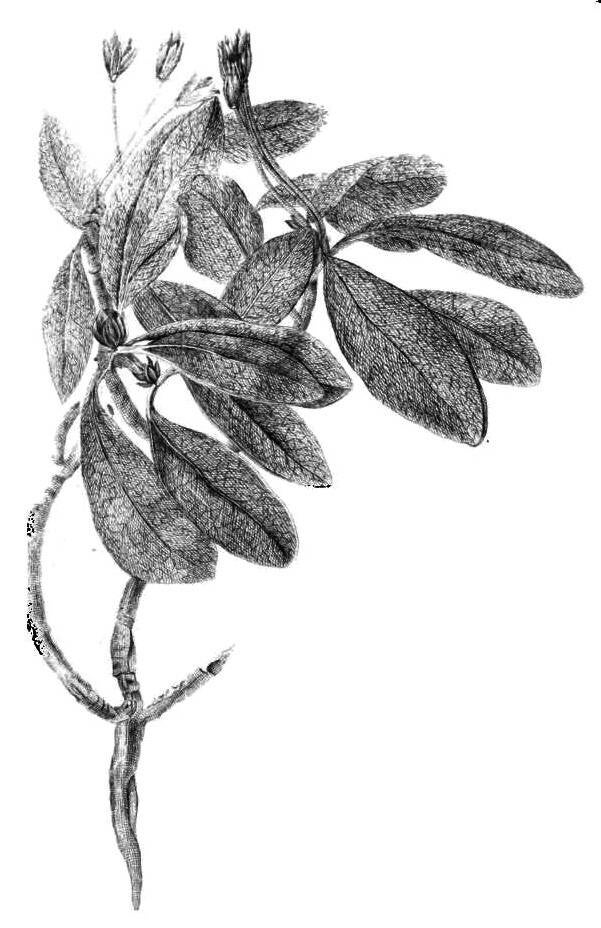
Rhododendron aureum in Johann Georg Gmelin's Flora Sibirica. Historical botanical plate, public domain. Source: Wikimedia Commons.
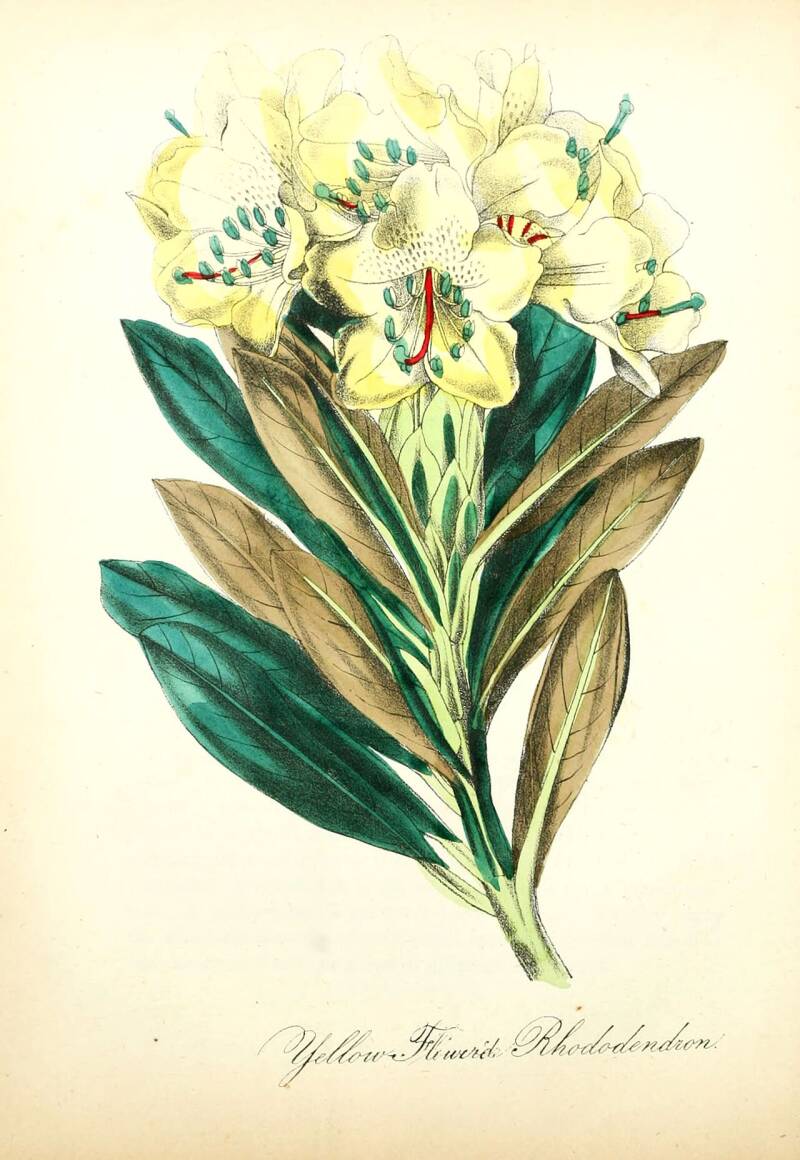
Rhododendron aureum, Plate 39 from The American Flora, vol. 1 (1855). Biodiversity Heritage Library / Mertz Library, New York Botanical Garden. Source: Wikimedia Commons (CC BY 2.0 scan; public-domain original).
Add comment
Comments