

Roger van Zandvoort
Human toxicological and clinical material assembled in the style of Allen’s Encyclopedia
This account brings together historical human clinical observations for Salamandra maculata [salam.], the fire salamander, also known as Salamandra salamandra. It is a compilation of reported observations rather than a proving.
No human proving was found in the sources searched. Animal experiments and observations concerning other amphibians are excluded from the numbered symptoms. The case summaries describe historical reports and their reported outcomes.
Superscript keys identify the authorities listed below. The symptom emphasis follows the supplied compilation; repeated quotations are not additional patients.
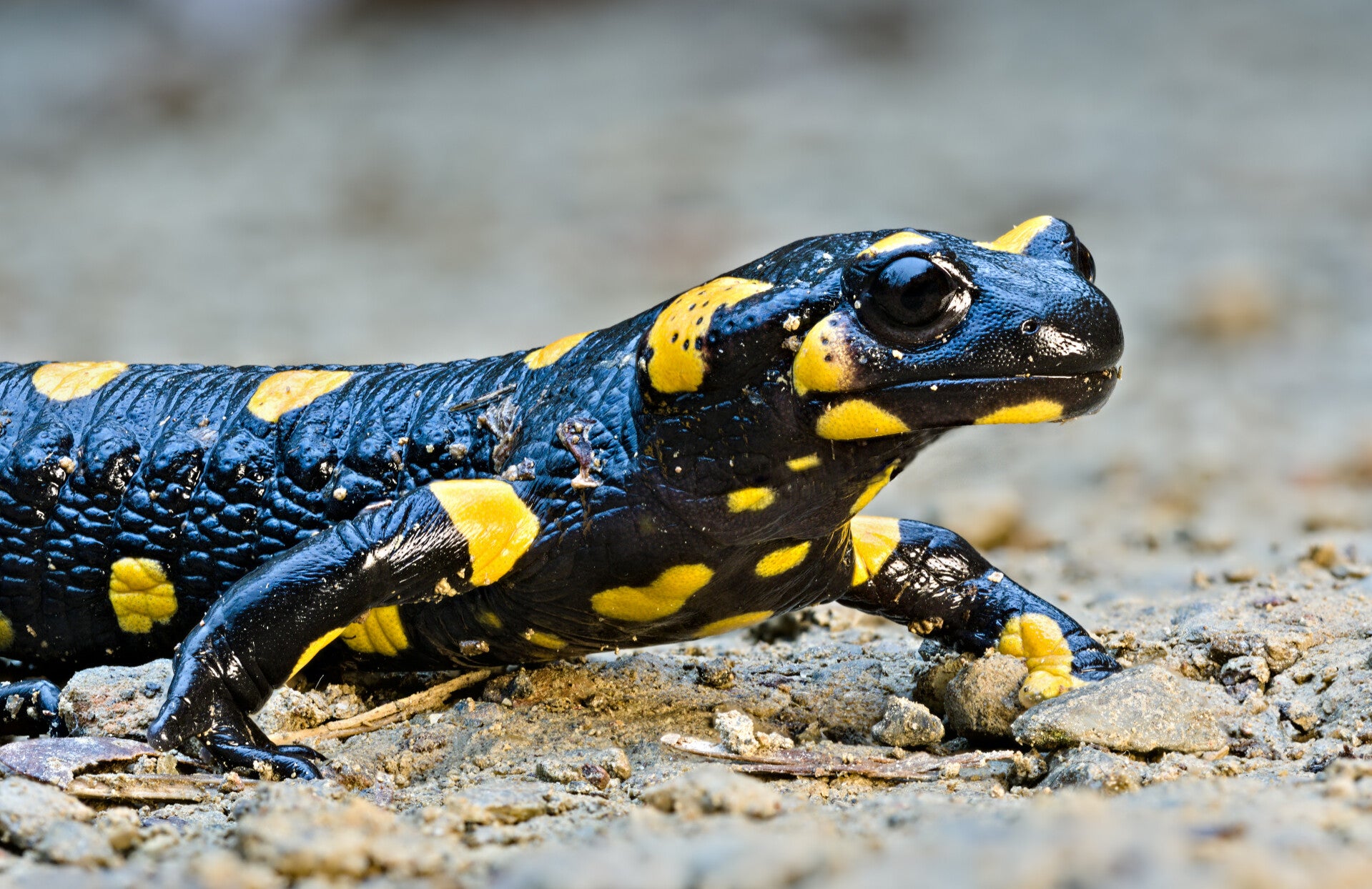
The animal and its classification
Salamandra salamandra (Linnaeus, 1758) is the common fire salamander. Other names recorded in Commons include vuursalamander (Dutch), Feuer Salamander (German), salamandre tachetée (French) and Salamandra Común (Spanish).
Its classification is: domain Eukaryota; kingdom Animalia; phylum Chordata; subphylum Vertebrata; infraphylum Gnathostomata; superclass Tetrapoda; class Amphibia; subclass Lissamphibia; order Caudata; suborder Salamandroidea; family Salamandridae; genus Salamandra; species Salamandra salamandra.
Historically, the preparation described for this remedy was a tincture of the secretion of the dermal glands.
Classification and common names: Wikimedia Commons, as recorded in Curar V4. Species information and names in other languages.
Authorities
1a, 1b. Leydet, Bereitung und Anwendung von Bufo und Salamandra, Allgemeine homöopathische Zeitung 58 (1859), pp. 78–80. Cases: Bernou (1a), Serres (1b). The journal identifies its source as the February 1859 Journal de la Société Gallicane de Médecine Homéopathique.
2, 2a–2e. Carl Bojanus, Homöopathische Therapeutik in ihrer Anwendung auf die operative Chirurgie (Stuttgart: J. F. Steinkopf, 1880), chapter Die Epilepsie. Digitized-copy record links to HathiTrust; reader access may vary. Cases: Nr. 6 (2a), Nr. 7 (2b), Nr. 11 (2c), Nr. 29 (2d), and the woman whose treatment began in 1860 (2e).
3. D. Albert Hillyer, Give them their proper place, Hahnemannian Advocate 36, no. 6 (15 June 1897), pp. 360–361; Salamandra passage p. 360.
5. Boericke, Pocket Manual; Hering, Guiding Symptoms; Kent, Repertory (clinical indications and repertory references, not a proving). 7. Boericke, Pocket Manual, 1916 (repertory confirmation). These are books, not journal articles.
Additional repertory-linked reference. Joseph Baertl, The homoeopathic treatment of epilepsy, British Journal of Homoeopathy 22 (1864), p. 245 ff. This is a secondary clinical/repertory reference, not an additional independently documented Salamandra patient.
Kent, Repertory: Salamandra entry (later reversed online transcription). Rampold, MINDMAT: publisher’s sample of volume 9, not the complete book.
MIND
[1.] • Anxiety and confusion before the attack, as if he would become insane2a.
Bojanus, Die Epilepsie, 1880, Nr. 6 (man 28)
[2.] • Fear of insanity before the attack2a.
Bojanus, Die Epilepsie, 1880, Nr. 6 (man 28)
VERTIGO
[3.] • Vertigo during convulsions and fainting-spells3.
D. Albert Hillyer, Give them their proper place, Hahnemannian Advocate, 1897, 36, 360
HEAD
[4.] • Dull left-sided headache1b.
Leydet, Bereitung und Anwendung von Bufo und Salamandra, Allgemeine homöopathische Zeitung, 1859, 58, 78–80 (Serres)
EYES
[5.] • Left eyelid paralyzed and hanging down1b.
Leydet, Bereitung und Anwendung von Bufo und Salamandra, Allgemeine homöopathische Zeitung, 1859, 58, 78–80 (Serres)
FACE
[6.] • Face red, then pale during the attacks2b.
Bojanus, Die Epilepsie, 1880, Nr. 7 (man 65: red, then pale)
[7.] • Livid, dark-red face during the attacks2c.
Bojanus, Die Epilepsie, 1880, Nr. 11 (woman 25: livid, dark-red)
MOUTH
[8.] • Tongue bitten during the attacks2a,2b,2e.
Bojanus, Die Epilepsie, 1880, Nr. 6 (man 28), Nr. 7 (man 65), and woman 1860 (clinical: tongue bitten; no toxicology source found)
[9.] • Bloody foam at the mouth during convulsions2e.
Bojanus, Die Epilepsie, 1880, woman 1860
[10.] • Tongue so sore after the attack that eating and speaking are painful2a.
Bojanus, Die Epilepsie, 1880, Nr. 6 (man 28)
URINARY ORGANS
[11.] • Involuntary urine during the attacks1b,2e.
Leydet, Bereitung und Anwendung von Bufo und Salamandra, Allgemeine homöopathische Zeitung, 1859, 58, 78–80 (Serres); Bojanus, Die Epilepsie, 1880 (woman, 1860)
CHEST
[12.] • Chronic lung catarrh1b.
Leydet, Bereitung und Anwendung von Bufo und Salamandra, Allgemeine homöopathische Zeitung, 1859, 58, 78–80 (Serres)
HEART AND PULSE
[13.] • Double heartbeat (sycotic heartbeat)2d.
Bojanus, Die Epilepsie, 1880, Nr. 29 (woman 26)
BACK
[14.] • Caries of the dorsal vertebrae with a fist-sized swelling1a.
Leydet, Bereitung und Anwendung von Bufo und Salamandra, Allgemeine homöopathische Zeitung, 1859, 58, 78–80 (Bernou)
EXTREMITIES
[15.] • Weakness of the legs; cannot walk without a stick1a,1b.
Leydet, Bereitung und Anwendung von Bufo und Salamandra, Allgemeine homöopathische Zeitung, 1859, 58, 78–80 (Bernou; Serres)
[16.] • Paralysis of the lower limbs3.
D. Albert Hillyer, Give them their proper place, Hahnemannian Advocate, 1897, 36, 360
[17.] • Convulsions predominantly in the upper limbs2a.
Bojanus, Die Epilepsie, 1880, Nr. 6 (man 28)
[18.] • Marble-cold upper limbs2a.
Bojanus, Die Epilepsie, 1880, Nr. 6 (man 28)
[19.] • Motor phenomena predominantly on the left side2c.
Bojanus, Die Epilepsie, 1880, Nr. 11 (woman 25)
[20.] • Suppurating nails on hands and feet2b.
Bojanus, Die Epilepsie, 1880, Nr. 7 (man 65)
SLEEP
[21.] • Profound sleep after the attack2e.
Bojanus, Die Epilepsie, 1880, woman 1860
[22.] • Sleeplessness from stitches in the skin1b.
Leydet, Bereitung und Anwendung von Bufo und Salamandra, Allgemeine homöopathische Zeitung, 1859, 58, 78–80 (Serres)
FEVER
[23.] • Morning sweats1b.
Leydet, Bereitung und Anwendung von Bufo und Salamandra, Allgemeine homöopathische Zeitung, 1859, 58, 78–80 (Serres)
SKIN
[24.] • Stitches in the skin1b.
Leydet, Bereitung und Anwendung von Bufo und Salamandra, Allgemeine homöopathische Zeitung, 1859, 58, 78–80 (Serres)
[25.] • Skin eruption1b.
Leydet, Bereitung und Anwendung von Bufo und Salamandra, Allgemeine homöopathische Zeitung, 1859, 58, 78–80 (Serres)
GENERALITIES
[26.] • Epileptiform fainting-spells3,2b.
D. Albert Hillyer, Give them their proper place, Hahnemannian Advocate, 1897, 36, 360 (cured: fainting-spells); Bojanus, Die Epilepsie, 1880, Nr. 7 (man 65: fainting followed by an epileptic attack)
Repertory: Boericke, Repertory, 1905; Boericke, Pocket Manual, 1916; Rampold, MINDMAT, 1998
[27.] • Convulsions with loss of consciousness2e,3.
Bojanus, Die Epilepsie, 1880, woman 1860 (cured: convulsions with loss of consciousness); D. Albert Hillyer, Give them their proper place, Hahnemannian Advocate, 1897, 36, 360 (cured: convulsions and fainting)
Repertory: Boericke, Repertory, 1905; Boericke, Pocket Manual, 1916; Rampold, MINDMAT, 1998; Joseph Baertl, The homoeopathic treatment of epilepsy, British Journal of Homoeopathy, 1864, 22, 245 ff.
[28.] • Attacks monthly, at night or in the morning2a.
Bojanus, Die Epilepsie, 1880, Nr. 6 (man 28)
[29.] • Attacks from fright or fear3,2a.
D. Albert Hillyer, Give them their proper place, Hahnemannian Advocate, 1897, 36, 360 (cured: fright aggravates); Bojanus, Die Epilepsie, 1880, Nr. 6 (man 28: anxiety and fear of insanity before the attacks)
Repertory: Bojanus, Die Epilepsie, 1880; D. Albert Hillyer, Give them their proper place, Hahnemannian Advocate, 1897, 36, 360 (the rubric is supported by these same two clinical sources)
[30.] • Looking downward aggravates3,7.
D. Albert Hillyer, Give them their proper place, Hahnemannian Advocate, 1897, 36, 360 (cured: looking downward aggravates); Boericke, Pocket Manual, 1916 (repertory confirmation); Kent, Repertory (reversed) (repertory confirmation)
Repertory: Boericke, Pocket Manual, 1916; Kent, Repertory (reversed)
[31.] • Looking upward aggravates3.
D. Albert Hillyer, Give them their proper place, Hahnemannian Advocate, 1897, 36, 360 (cured: looking upward aggravates); no second Salamandra source found
Repertory: D. Albert Hillyer, Give them their proper place, Hahnemannian Advocate, 1897, 36, 360 (sole repertory source)
HUMAN TOXICOLOGY (SECONDARY)
Secondary accounts of human toxicology for S. salamandra mainly describe local irritation: irritation of the skin and mucous membranes; eye projection can cause keratitis, corneal edema, conjunctival hyperemia, and temporary blindness. Systemic digitalis-like signs are attributed to certain tropical species, not S. salamandra. These are secondary review statements, not two independent case observations, and are considered separately from the clinical cases.
CLINICAL INDICATION (SECONDARY)
Boericke, Pocket Manual (1916), gives “Epilepsy and softening of brain” and lists Salamandra as complementary to Bufo. Hering’s Guiding Symptoms repeats “Complementary: Salamandra (epilepsy, cerebral softening).” Kent’s reversed repertory preserves the two “looking downward” rubrics. These are secondary clinical indications, not a proving, and are not numbered as symptoms.
CLINICAL CASES
Leydet 1859 — Bernou. Bernou, 24, lymphatic: three months of leg pains, spinal caries with a fist-sized swelling, unable to walk without a stick; Bufo first dilutions for two months, then Salamandra; walked 14 km without a stick and resumed farm work.
Leydet 1859 — Serres. Serres, 69: chronic lung catarrh, skin stitches preventing sleep, convulsions of the limbs, weak legs, involuntary urine, left-sided dull headache, left eyelid paralysis; Bufo then Salamandra; by 10 December 1858 the skin eruption and convulsions had gone, he walked without a stick, held urine all night, and had morning sweats.
Bojanus Nr. 6 — man 28. Epilepsy since childhood, monthly nocturnal/morning attacks, aura of anxiety and confusion, tongue bites, marble-cold upper limbs, convulsions predominantly in the upper limbs; Bufo then Salamandra 6/x, no attacks after 5 October 1874.
Bojanus Nr. 7 — man 65. Monthly attacks, facial redness then pallor, tongue bites, suppurating nails; Bufo then Salamandra 12/x, no relapse for three years.
Bojanus Nr. 11 — woman 25. Epilepsy after forceps delivery, 52–54 attacks a year, left-sided motor phenomena, livid face; Bufo and Salamandra 12/x alternating, no relapse for 17 years.
Bojanus Nr. 29 — woman 26. Arm aura with a sensation of rotating movements, double heartbeat; improved, no relapse for 1.5 years.
Bojanus — woman, 1860. Convulsions with loss of consciousness, bloody foam, tongue biting, involuntary urine, post-ictal sleep; after Bufo and Salamandra, last attack February 1861, no attacks for 17 years.
Hillyer 1897. A very stubborn case of epileptiform fainting-spells with vertigo and paralytic symptoms in both lower extremities; fright, looking upward, or looking downward greatly aggravated. Cured with Salamandra. Hillyer compares Salamandra with Lachesis and Crotalus.
Photograph: Petar Milošević, Wikimedia Commons, CC BY-SA 4.0. Fire salamander in Slovenia. Photograph unaltered.

Add comment
Comments